Seven years before the main story
Marley's Death Established
The narrative opens by firmly establishing the death of Jacob Marley, Scrooge's former business partner. The register of his burial was signed by the clergyman, the clerk, the undertaker, and the chief mourner—Scrooge himself. Marley's death is presented as an absolute certainty, as dead as a door-nail, a necessary precondition for the supernatural events to follow. Scrooge, far from being grief-stricken, conducted business as usual on the very day of the funeral, sealing an undoubted bargain. The firm's name, Scrooge and Marley, remains unchanged above the warehouse door, and Scrooge answers to both names, a testament to his unchanging, miserly nature.
Early in the story, before Christmas Eve
Scrooge's Miserly Character Described
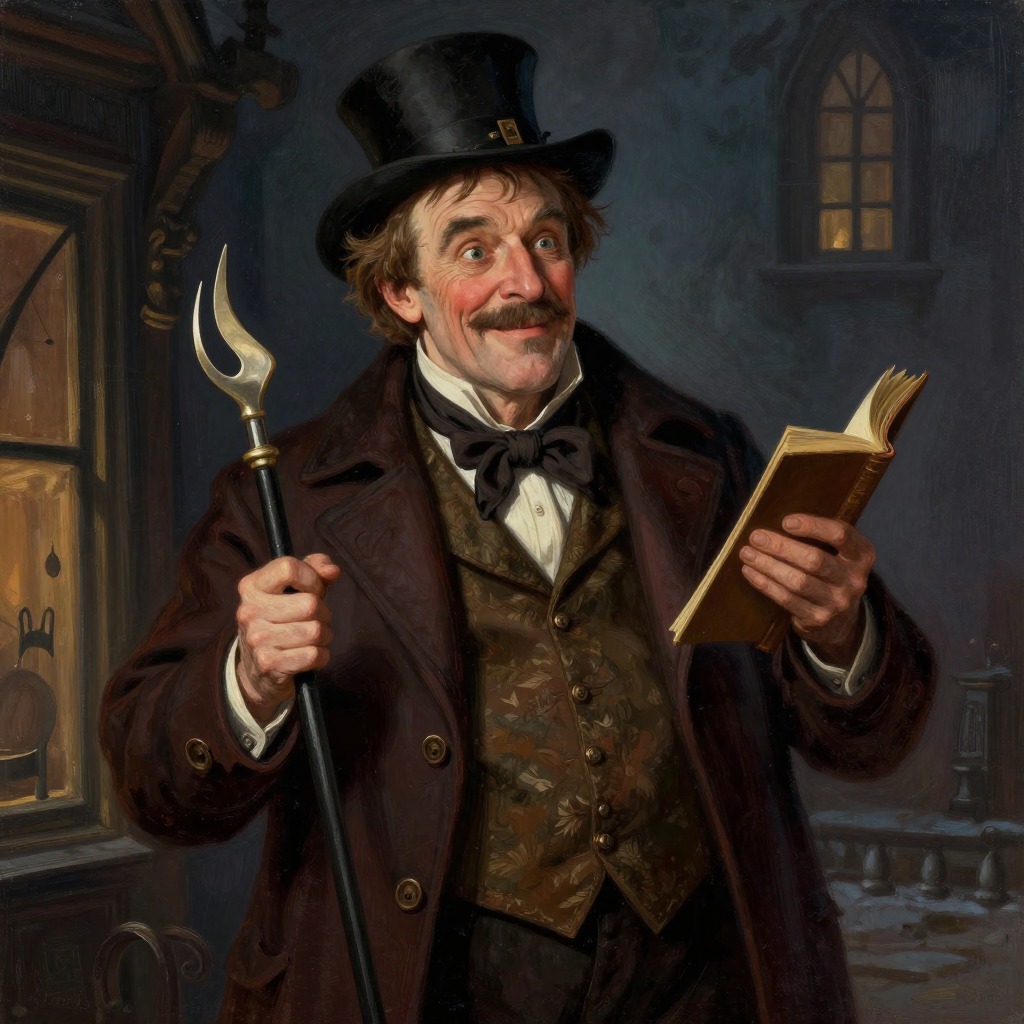
The narrator provides a vivid portrait of Ebenezer Scrooge, a tight-fisted, grasping, solitary old sinner. He is as hard and sharp as flint, carrying his own low temperature wherever he goes, icing his office even in the dog days. No one ever stops him with a friendly greeting; even blind men's dogs tug their owners into doorways to avoid him. Scrooge revels in this isolation, warning all human sympathy to keep its distance. This characterization establishes him as the embodiment of avarice and misanthropy, setting the stage for his profound transformation.
Christmas Eve, late afternoon
Scrooge in His Counting-House
On a cold, bleak, foggy Christmas Eve, Scrooge sits busy in his counting-house. The City clocks have just struck three, but it is already dark. He keeps his eye on his clerk, Bob Cratchit, who works in a dismal little cell, a sort of tank, copying letters. Scrooge's fire is small, but the clerk's fire is even smaller, a single coal, and Scrooge keeps the coal-box in his own room to prevent the clerk from replenishing it. The clerk tries to warm himself at the candle, but fails. This scene establishes the oppressive working conditions and the stark power imbalance between Scrooge and his employee.
Christmas Eve, late afternoon
Fred's Christmas Visit
Scrooge's cheerful nephew, Fred, bursts into the counting-house, exclaiming 'A merry Christmas, uncle! God save you!' Scrooge retorts with his characteristic 'Bah! Humbug!' and launches into a tirade against Christmas, calling it a time for paying bills without money and finding oneself a year older and not an hour richer. Fred, undeterred, eloquently defends Christmas as a kind, forgiving, charitable, pleasant time, the only time when men and women open their shut-up hearts freely. He invites Scrooge to dine with him and his wife the next day, but Scrooge refuses with a rude and vulgar expression. Fred leaves without anger, bestowing the season's greetings on the clerk, who returns them cordially, much to Scrooge's annoyance.
Christmas Eve, late afternoon
The Portly Gentlemen's Appeal
Two portly gentlemen enter the counting-house, seeking a donation for the poor and destitute at Christmas. They explain that many thousands are in want of common necessaries and comforts. Scrooge, with cold sarcasm, asks if the prisons and workhouses are still in operation, and upon being told they are, he expresses gladness. He refuses to give anything, stating that he helps to support the establishments he has mentioned and that those who are badly off must go there. When told that many would rather die, Scrooge callously retorts that they had better do so and 'decrease the surplus population.' The gentlemen withdraw, seeing it is useless to pursue their point.
Christmas Eve, evening
The Carol Singer Driven Away
As the fog and darkness thicken, a young boy approaches Scrooge's keyhole to sing a Christmas carol. At the first sound of 'God bless you, merry gentleman, May nothing you dismay!' Scrooge seizes his ruler with such energy that the singer flees in terror. This incident further illustrates Scrooge's hostility towards any expression of Christmas cheer and his complete lack of compassion, even for a child.
Christmas Eve, closing time
Scrooge Dismisses Bob Cratchit
At the hour of shutting up the counting-house, Scrooge grudgingly admits the fact to the expectant clerk. He grudgingly grants Bob Cratchit the whole day off for Christmas, but complains that it is not fair and that he is picking his pocket. He insists that the clerk be there all the earlier the next morning. The office is closed in a twinkling, and the clerk, with his white comforter dangling, goes down a slide on Cornhill twenty times in honour of Christmas Eve before running home to Camden Town.
Christmas Eve, night
Scrooge Returns Home
Scrooge takes his melancholy dinner in his usual melancholy tavern, reads the newspapers, and beguiles the rest of the evening with his banker's book before going home to his chambers. These chambers once belonged to his deceased partner, Jacob Marley, and are a gloomy suite of rooms in a dark, dreary yard. The fog and frost hang about the black old gateway. This setting establishes the atmosphere of isolation and foreboding that precedes the supernatural visitation.
Christmas Eve, night, at Scrooge's door
Marley's Face in the Door Knocker
As Scrooge puts his key in the lock of his door, he sees, to his astonishment, that the door knocker has transformed into the face of Jacob Marley. It is not a knocker, but Marley's face, with a dismal light about it, ghostly spectacles on its forehead, and hair curiously stirred. The eyes are wide open but perfectly motionless, and its livid colour makes it horrible. As Scrooge looks fixedly, it becomes a knocker again. Though startled, he puts his hand on the key, turns it sturdily, walks in, and lights his candle, trying to dismiss the vision.
Christmas Eve, night, in Scrooge's chambers
Scrooge Checks His Rooms
After entering his chambers, Scrooge, with a moment's irresolution, checks behind the door and then walks through his rooms to ensure all is right. He examines the sitting-room, bedroom, and lumber-room, finding nobody under the table, sofa, or bed, and nobody in the closet or his dressing-gown. Satisfied, he double-locks himself in, a departure from his custom, and puts on his dressing-gown, slippers, and nightcap before sitting down before a very low fire to take his gruel.
Christmas Eve, night, in Scrooge's chambers
The Bell and the Clanking Noise
As Scrooge sits brooding over the fire, a disused bell in the room begins to swing softly, then rings out loudly, followed by every bell in the house. The bells cease, and a clanking noise is heard deep below, as if someone is dragging a heavy chain over the casks in the wine merchant's cellar. The cellar door flies open, and the noise comes up the stairs, straight towards Scrooge's door. Despite his attempts to dismiss it as 'humbug,' his colour changes as the sound passes through the heavy door into the room.
Christmas Eve, night, in Scrooge's chambers
Marley's Ghost Appears to Scrooge
Marley's Ghost enters Scrooge's room, the same face as in life, with his pigtail, waistcoat, tights, and boots. He drags a long, heavy chain made of cash-boxes, keys, padlocks, ledgers, deeds, and heavy purses, clasped about his middle. His body is transparent, and Scrooge can see the two buttons on his coat behind. Scrooge, though terrified, tries to maintain his composure, even joking that the Ghost might be an undigested bit of beef. The Ghost, however, raises a frightful cry and shakes its chain, causing Scrooge to fall to his knees and beg for mercy.
Christmas Eve, night, in Scrooge's chambers
Marley's Warning and Prophecy
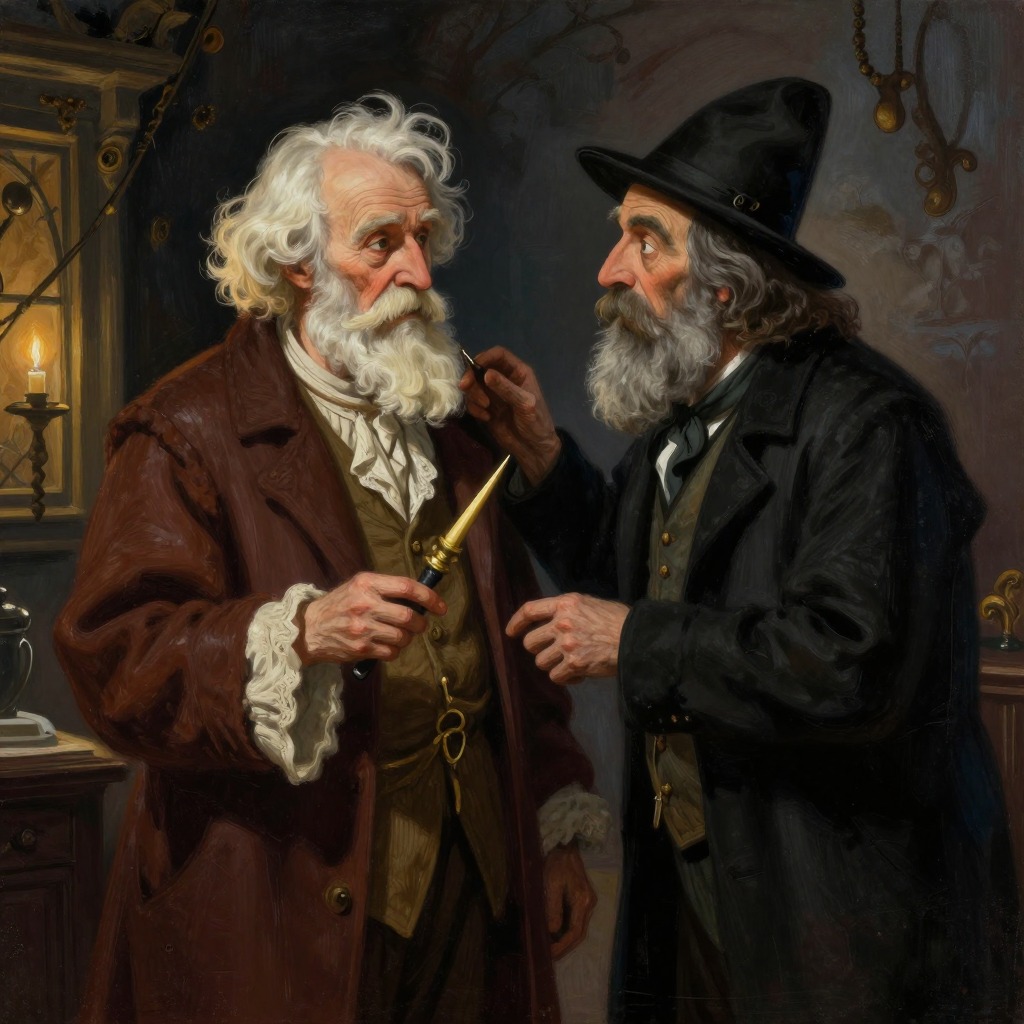
Marley's Ghost explains that he is doomed to wander the earth, witnessing what he cannot share, because his spirit never walked beyond the narrow limits of their money-changing hole in life. He tells Scrooge that he wears the chain he forged in life, link by link, and that Scrooge's own chain is even longer and heavier. The Ghost warns Scrooge that he has a chance and hope of escaping his fate, but only through the visitation of Three Spirits. The first will come the next night when the bell tolls One, the second the next night at the same hour, and the third upon the next night when the last stroke of Twelve has ceased to vibrate.
Christmas Eve, night, in Scrooge's chambers
Marley's Ghost Departs
After delivering his warning, Marley's Ghost binds its wrapper around its head again and walks backward towards the window, which raises itself as it approaches. The Ghost beckons Scrooge, who approaches, and then holds up its hand, warning him to come no nearer. Scrooge hears confused noises in the air, wailings of lamentation and regret. The Ghost joins in the mournful dirge and floats out into the bleak, dark night. Scrooge looks out and sees the air filled with phantoms, wandering in restless haste, all wearing chains like Marley's. He closes the window, examines the door, and, unable to say 'Humbug!', goes to bed and falls asleep instantly.
Christmas night, around 12:00 AM
Scrooge Awakens to the First Spirit
Scrooge awakens in the dark and is astonished to hear the church bell strike twelve, though he went to bed past two. He checks his repeater, which also strikes twelve. After much perplexity, he remembers Marley's warning and resolves to lie awake until the bell tolls one. When the hour finally sounds, a light flashes up in the room, and the curtains of his bed are drawn aside by a hand. Scrooge finds himself face to face with a strange figure: like a child, yet like an old man, with white hair, a tunic of purest white, a lustrous belt, and a branch of fresh green holly. From the crown of its head springs a bright, clear jet of light. This is the Ghost of Christmas Past.
Christmas night, during the First Spirit's visit
Journey to Scrooge's Boyhood
The Ghost of Christmas Past clasps Scrooge by the arm and, despite his protests, they pass through the wall and stand upon an open country road. Scrooge recognizes the place as where he was bred as a boy. They walk along the road, and Scrooge recognizes every gate, post, and tree. They see jocund travellers on ponies and in gigs, all shouting 'Merry Christmas' to each other. Scrooge is filled with inexplicable gladness at the sight, his cold eye glistening and his heart leaping up.
Christmas night, during the First Spirit's visit
The Lonely Schoolboy
The Spirit leads Scrooge to a large, dilapidated boarding school. They enter a long, bare, melancholy room where a solitary boy, the young Scrooge, is reading near a feeble fire. Scrooge weeps to see his poor forgotten self. The Spirit points to the boy, and Scrooge, in a moment of ecstasy, sees characters from his childhood reading come to life outside the window: Ali Baba, Valentine and Orson, and Robin Crusoe's parrot. Scrooge, with a voice between laughing and crying, expresses pity for his former self and wishes he had given something to the boy who sang a carol at his door the previous night.
Christmas night, during the First Spirit's visit
Fan Brings Scrooge Home
The scene shifts to another Christmas in Scrooge's boyhood. The room is darker and dirtier, and the young Scrooge is walking up and down despairingly. The door opens, and his little sister, Fan, comes darting in, embracing him and calling him her 'dear, dear brother.' She tells him that their father has become much kinder and that she has come to bring him home for good. They leave the school together, with the schoolmaster glaring at them. The Ghost tells Scrooge that Fan died a woman and had one child: his nephew, Fred. Scrooge seems uneasy at this reminder.
Christmas night, during the First Spirit's visit
The Fezziwig Christmas Party
The Spirit takes Scrooge to the warehouse of his old employer, Fezziwig. They see a younger Scrooge, now a young man, with his fellow apprentice, Dick Wilkins. Old Fezziwig, a jovial, generous man, calls a halt to work and transforms the warehouse into a ballroom for a Christmas party. A fiddler arrives, and the room fills with guests, including Mrs. Fezziwig and the three Miss Fezziwigs. There are dances, forfeits, cake, negus, and a great piece of Cold Roast and Cold Boiled. The evening culminates in the dance 'Sir Roger de Coverley,' with Fezziwig and his wife leading the company. Scrooge, watching, is transported with joy, remembering every detail.
Christmas night, during the First Spirit's visit
Scrooge's Regret and the Lesson of Fezziwig
After the Fezziwig party scene, the Ghost comments that a small matter like spending a few pounds has made these silly folks so full of gratitude. Scrooge, heated by the remark, defends Fezziwig, arguing that the happiness he gives is quite as great as if it cost a fortune, and that his power lies in words and looks. The Spirit's glance makes Scrooge stop, and he admits that he should like to be able to say a word or two to his clerk just now. This moment marks the first stirring of empathy in Scrooge, as he begins to see the contrast between Fezziwig's generosity and his own miserly treatment of Bob Cratchit.
Christmas night, during the First Spirit's visit
Belle Releases Scrooge
The Spirit shows Scrooge a later scene: he is older, with the signs of care and avarice beginning to show on his face. He sits beside a fair young girl in mourning, Belle, who is releasing him from their engagement. She tells him that a 'golden idol'—the pursuit of wealth—has displaced her in his heart. Scrooge protests that he is not changed towards her, but she insists that he is, and that their contract, made when they were both poor and content, is now fraught with misery. She releases him, saying she does so for the love of the man he once was. Scrooge, watching, cries out for the Spirit to show him no more.
Christmas night, during the First Spirit's visit
Belle's Happy Family
Despite Scrooge's pleas, the Ghost forces him to witness one more shadow. They are in a comfortable, happy home where Belle, now a comely matron, sits with her husband and a large, boisterous family. The husband returns home laden with Christmas toys and presents, and the children rush to greet him. The husband tells Belle that he saw Mr. Scrooge that afternoon, sitting alone in his office while his partner lies upon the point of death. Scrooge, seeing the happiness he has missed, is overcome with anguish and wrestles with the Spirit, finally seizing the extinguisher cap and pressing it down upon the Spirit's head to force it to stop.
Christmas night, around 1:00 AM
Scrooge Awakens to the Second Spirit
Scrooge awakens in his own bedroom, exhausted, and hears the bell strike one again. He is prepared for the second messenger, but when no shape appears, he is taken with a violent fit of trembling. He notices a blaze of ruddy light streaming from the adjoining room and, tracing it, shuffles to the door. A strange voice calls him by name and bids him enter. He obeys and finds his own room transformed into a kind of grove, hung with living green, holly, mistletoe, and ivy, with a mighty blaze roaring up the chimney. Heaped on the floor is a throne of food: turkeys, geese, game, poultry, brawn, great joints of meat, sucking-pigs, sausages, mince-pies, plum-puddings, oysters, chestnuts, apples, oranges, pears, twelfth-cakes, and bowls of punch. Upon this couch sits a jolly Giant, the Ghost of Christmas Present.
Christmas night, during the Second Spirit's visit
The Ghost of Christmas Present's Appearance
The Ghost of Christmas Present is a jolly Giant, clothed in a simple deep green robe bordered with white fur, with a bare chest and bare feet. On its head is a holly wreath set with icicles, and it has dark brown curls, a sparkling eye, and an open hand. It carries a glowing torch, shaped like Plenty's horn. The Spirit tells Scrooge that it has more than eighteen hundred brothers and that its life upon this globe is very brief, ending that night at midnight. Scrooge, now submissive, asks to be conducted wherever the Spirit will, and the Spirit bids him touch its robe.
Christmas Day, morning
Christmas Morning in the City
Scrooge and the Spirit stand in the city streets on Christmas morning. The weather is severe, but the people are jovial, shovelling snow from the housetops and exchanging facetious snowballs. The poulterers' and grocers' shops are radiant with Christmas fare. The Spirit sprinkles incense from his torch on the dinners being carried to the bakers' shops, and when there are angry words between some dinner-carriers, he sheds a few drops of water from it, restoring their good humour. Scrooge asks about the peculiar flavour of the torch, and the Spirit replies that it is his own, and that it applies to any kindly given dinner, but most to a poor one because it needs it most.
Christmas Day, afternoon
The Cratchit Family Christmas Dinner
The Spirit takes Scrooge to the home of Bob Cratchit. The family is preparing their Christmas dinner, a goose, with great excitement. Mrs. Cratchit, Belinda, and Martha are busy, while Master Peter Cratchit and the two younger Cratchits help. Bob arrives with Tiny Tim on his shoulder, who bears a little crutch and has his limbs supported by an iron frame. The family enjoys a meagre but joyful feast, with the goose being a great success. After dinner, Bob proposes a toast: 'A merry Christmas to us all, my dears. God bless us!' and Tiny Tim adds, 'God bless us every one!'
Christmas Day, during the Cratchit dinner
Scrooge Asks About Tiny Tim's Fate
Moved by the scene, Scrooge asks the Spirit if Tiny Tim will live. The Ghost replies that it sees a vacant seat in the poor chimney-corner and a crutch without an owner, and that if these shadows remain unaltered by the Future, the child will die. The Spirit then quotes Scrooge's own words back to him: 'If he be like to die, he had better do it, and decrease the surplus population.' Scrooge hangs his head, overcome with penitence and grief. The Spirit rebukes him, asking if he will decide what men shall live and what men shall die.
Christmas Day, during the Cratchit dinner
The Cratchits Toast Scrooge
After the dinner, Bob Cratchit proposes a toast to Mr. Scrooge, calling him 'the Founder of the Feast.' Mrs. Cratchit, however, is reluctant, calling Scrooge an odious, stingy, hard, unfeeling man. She eventually drinks the toast for her husband's sake and the Day's, but not for Scrooge's. The children drink after her, but it is the first of their proceedings which has no heartiness in it. Tiny Tim drinks it last of all, but he doesn't care twopence for it. The mention of Scrooge's name casts a dark shadow on the party, which is not dispelled for full five minutes.
Christmas Day, during the Second Spirit's visit
Journey to the Miners' Hut
The Spirit takes Scrooge to a bleak and desert moor, where miners live. They pass through the wall of a hut and find a cheerful company assembled around a glowing fire, with an old man singing a Christmas song. The Spirit then takes Scrooge to a solitary lighthouse on a dismal reef of sunken rocks, where two men who watch the light wish each other a Merry Christmas over their grog. Finally, they visit a ship at sea, where every man on board hums a Christmas tune or has a Christmas thought. These scenes demonstrate that the spirit of Christmas is present even in the most isolated and harsh environments.
Christmas Day, evening
Fred's Christmas Party
The Spirit brings Scrooge to his nephew Fred's house, where a lively Christmas party is in full swing. Fred laughs heartily, recounting how Scrooge said Christmas was a humbug. The guests, including Fred's wife, Topper, and the plump sister, play games like blindman's buff and forfeits. They play a game called 'Yes and No,' where Fred thinks of an animal, and the plump sister guesses it is 'your uncle Scrooge.' Fred then proposes a toast to Uncle Scrooge, and everyone drinks to his health. Scrooge, watching, is so engaged that he joins in the games, forgetting that his voice makes no sound in their ears.
Christmas night, near midnight
Ignorance and Want Revealed
As the night wears on, the Ghost of Christmas Present grows older. Scrooge notices its hair is grey, and the Spirit confirms that its life ends that night at midnight. The Spirit then shows Scrooge two wretched, abject children hiding beneath its robe: a boy named Ignorance and a girl named Want. The Spirit warns Scrooge to beware of them both, but most of all the boy, for on his brow is written 'Doom,' unless the writing be erased. When Scrooge asks if they have no refuge or resource, the Spirit turns on him with his own words: 'Are there no prisons? Are there no workhouses?'
Christmas night, midnight
The Ghost of Christmas Yet to Come Appears
As the bell strikes twelve, the Ghost of Christmas Present vanishes, and Scrooge sees a solemn Phantom approaching, draped and hooded, coming like a mist along the ground. This is the Ghost of Christmas Yet to Come. It is shrouded in a deep black garment, concealing its head, face, and form, leaving nothing visible save one outstretched hand. The Spirit neither speaks nor moves, but points onward with its hand. Scrooge, though terrified, declares that he is prepared to bear it company, hoping to live to be another man.
Future, during the Third Spirit's visit
Businessmen Discuss a Death
The Phantom takes Scrooge to the Royal Exchange, where a group of businessmen are talking. They discuss the death of a man, with one saying, 'I only know he's dead.' They speculate about his money and joke about his funeral being cheap, with one offering to go if a lunch is provided. Scrooge knows the men and looks to the Spirit for an explanation. The Phantom then points to two other businessmen who meet and briefly exchange words, with one saying, 'Old Scratch has got his own at last, hey?' Scrooge is puzzled but resolves to treasure up every word, suspecting a latent moral for his own improvement.
Future, during the Third Spirit's visit
The Plundering of the Dead Man's Goods
The Spirit leads Scrooge to a low-browed shop in a foul, narrow part of town, where old Joe buys old rags, bottles, bones, and iron. Three people enter: a charwoman, a laundress (Mrs. Dilber), and an undertaker's man, each carrying bundles of goods they have stolen from the dead man's house. They laugh and joke as old Joe appraises the items: bed-curtains, sheets, towels, silver teaspoons, sugar-tongs, boots, and even the shirt from the dead man's back. The charwoman says, 'He frightened every one away from him when he was alive, to profit us when he was dead!' Scrooge watches in horror, realizing that this could be his own fate.
Future, during the Third Spirit's visit
The Corpse in the Dark Room
The scene changes, and Scrooge finds himself in a dark, bare room where a corpse lies on a bed, plundered and bereft, unwatched, unwept, uncared for. The Phantom's hand points to the head. Scrooge longs to withdraw the veil to see the face but has no power to do so. He hears a voice in his thoughts, reflecting on the cold, rigid, dreadful Death, and contrasting it with the loved, revered, and honoured head. He thinks that if this man could be raised up now, his foremost thoughts would be avarice and hard dealing, which have brought him to a rich end. The room is empty, with a cat tearing at the door and rats gnawing beneath the hearth-stone.
Future, during the Third Spirit's visit
The Debtors' Relief
Scrooge begs the Spirit to show him someone who feels emotion caused by this man's death. The Phantom reveals a room where a young couple, Caroline and her husband, are discussing the death of their creditor. The husband tells Caroline that the man is dead, and they are relieved, as they can now sleep with light hearts. Caroline is thankful in her soul, though she prays for forgiveness the next moment. The only emotion the Ghost can show Scrooge caused by the death is one of pleasure. Scrooge is horrified.
Future, during the Third Spirit's visit
Tiny Tim's Death
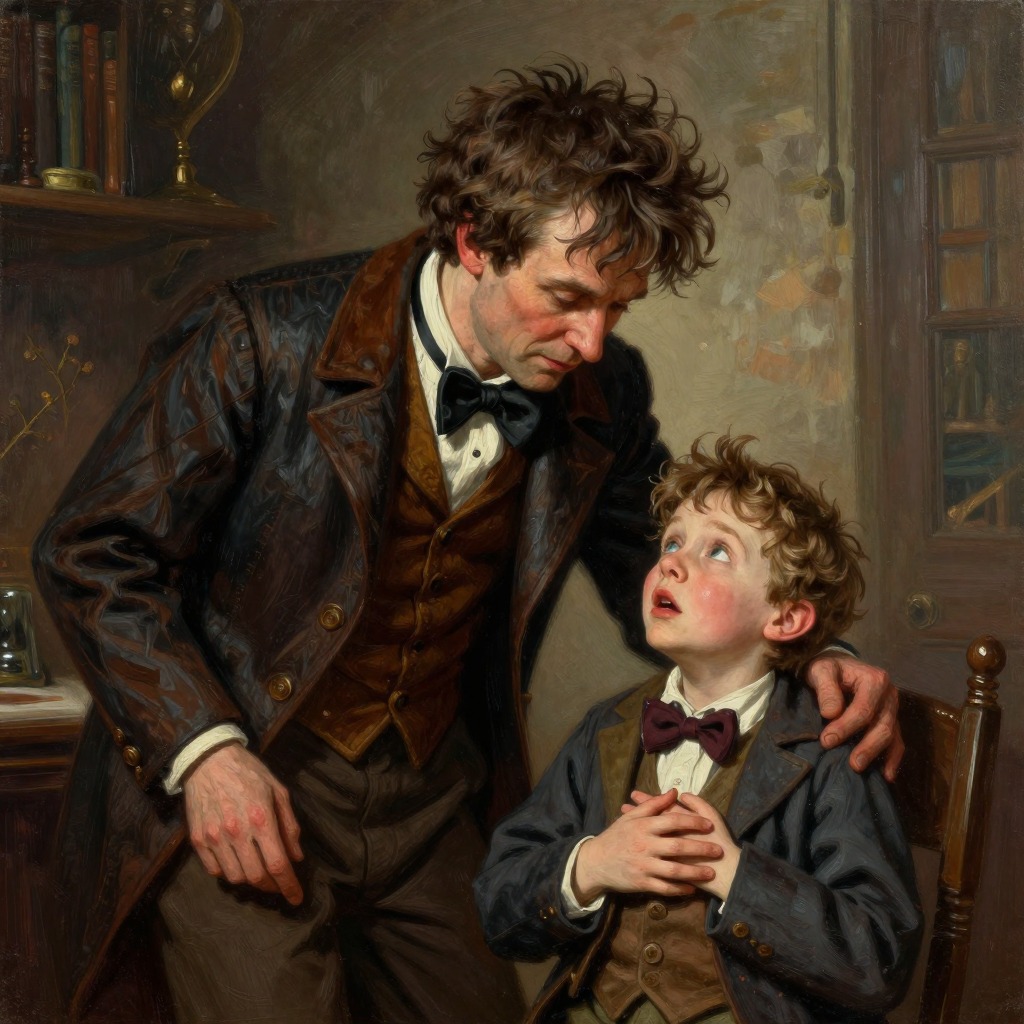
The Spirit takes Scrooge to the Cratchit home, where the family is gathered in quiet mourning. Tiny Tim has died. Mrs. Cratchit and the girls are sewing, and Peter reads from a book. Bob Cratchit arrives, and they all try to comfort him. Bob tells them that he has been to the churchyard and that he promised Tiny Tim he would walk there on a Sunday. He breaks down, crying, 'My little child!' He goes upstairs to the room where Tiny Tim's chair is set, kisses the little face, and comes down again reconciled. The family talks about the kindness of Scrooge's nephew, Fred, who offered his help. Scrooge is deeply affected.
Future, during the Third Spirit's visit
Scrooge's Own Grave
The Spirit leads Scrooge to a churchyard, overrun with grass and weeds, and points down to a neglected grave. Scrooge, trembling, asks if these are the shadows of things that Will be or things that May be only. The Spirit remains immovable. Scrooge creeps towards the grave and reads upon the stone his own name: Ebenezer Scrooge. He cries out, 'Am I that man who lay upon the bed?' and falls to his knees, pleading for a chance to change. He promises to honour Christmas in his heart and to live in the Past, the Present, and the Future. The Spirit's hand trembles, and Scrooge, in his agony, catches the spectral hand, but the Spirit repulses him and shrinks, collapsing into a bedpost.
Christmas Day, morning
Scrooge's Christmas Morning Awakening
Scrooge finds himself in his own bed, clutching his bed-curtains. He realizes that the bedpost is his own, the bed is his own, and the room is his own. He is overjoyed to discover that the time before him is his own to make amends in. He laughs and cries, declaring that he will live in the Past, the Present, and the Future. He dresses in a frenzy, opening the window to find a clear, bright, cold Christmas morning. He calls down to a boy in the street and learns that it is Christmas Day. He is ecstatic that he hasn't missed it.
Christmas Day, morning
Scrooge Sends the Prize Turkey to the Cratchits
Scrooge, in a burst of generosity, asks the boy if the poulterer's shop has sold the prize turkey that was hanging up. He instructs the boy to go and buy it, promising him a shilling, or half-a-crown if he returns in less than five minutes. The boy is off like a shot. Scrooge whispers to himself that he will send it to Bob Cratchit's, and that it is twice the size of Tiny Tim. He writes the address, though his hand is not steady, and goes downstairs to open the street door. When the poulterer's man arrives with the enormous turkey, Scrooge pays for it and a cab to deliver it to Camden Town, chuckling with delight.
Christmas Day, morning
Scrooge Meets the Portly Gentleman
Dressed in his best, Scrooge walks through the streets, smiling at everyone. He meets the portly gentleman who had come to his counting-house the day before for a donation. Scrooge takes him by both hands, apologizes for his previous behaviour, and whispers in his ear. The gentleman is astonished, and Scrooge assures him that he is serious, promising a large donation with many back-payments included. The gentleman shakes his hand, and Scrooge thanks him repeatedly, then goes to church and walks about the streets, finding that everything can yield him pleasure.
Christmas Day, afternoon
Scrooge Visits Fred's House
In the afternoon, Scrooge turns his steps towards his nephew's house. He passes the door a dozen times before he has the courage to knock. When the girl answers, he asks if his master is at home and then goes in. He finds Fred and his wife at the table, and Fred is astonished to see him. Scrooge asks to be let in for dinner, and Fred welcomes him with open arms, almost shaking his arm off. The party is wonderful, with games and happiness. Scrooge is at home in five minutes.
The day after Christmas, morning
Scrooge Raises Bob Cratchit's Salary
Scrooge is early at the office the next morning, determined to catch Bob Cratchit coming late. Bob arrives eighteen and a half minutes late, and Scrooge pretends to be angry, growling at him. But then he leaps from his stool, gives Bob a dig in the waistcoat, and announces that he is going to raise his salary. Bob is initially terrified, thinking Scrooge has gone mad, but Scrooge claps him on the back and wishes him a merrier Christmas than he has given him for many a year. He promises to assist his struggling family and to discuss his affairs that afternoon over a bowl of smoking bishop.
After Christmas Day
Scrooge's Lasting Transformation
Scrooge is better than his word. He does everything he promised and infinitely more. To Tiny Tim, who does not die, he becomes a second father. He becomes as good a friend, as good a master, and as good a man as the good old City knew. Some people laugh at the alteration in him, but he lets them laugh, knowing that his own heart laughs, and that is enough for him. He has no further intercourse with Spirits, but lives upon the Total-Abstinence Principle ever afterwards, and it is always said of him that he knows how to keep Christmas well.